Tag Archives: France

Guest Blogger: French School Lunches

Aidan Larson is an American mom of three navigating her way through life in France and writing about it on her blog: Conjugating Irregular Verbs. She writes from her dining room table in the South of France in between motherhood, French lessons and perfecting her oeuf en croute. Previous lives include teaching, copy editing and bookkeeping.
If we want our children to eat well and be healthy it’s not at all that complicated. It is a matter of starting young and teaching children that food should be enjoyed and appreciated.
In France food is serious business. Each region has their own cheese, culinary specialties and pride in what they produce. From an early age, eating as a family and at regular times is the norm. It sounds ridiculously simple, and it is.
Living in France you learn to think of food differently. While there are fast-food restaurants, they are few and far between compared to small cafes and sit down restaurants.  In the States there are drive through restaurants a plenty, shouting from billboards the latest menu deal where you can easily be tempted to drive through, grab a bag of calories and scarf it down in the car on your way somewhere.
When we are so used to eating this way it’s no surprise that our children choose a bag of chips and a soda from the vending machine or a greasy slice of pizza from the cafeteria line rather than sitting down for a proper meal. In France, the mid-day meal is the feast; the biggest and most nutritious meal you’ll have all day. There is a small breakfast of yogurt and cereal with warm chocolate milk or juice. And a snack in the late afternoon followed by a small something like a cheese crepe or baguette with chestnut spread in the evening. Between noon and two is lunch time and most French observe this without exception. Stores and pharmacies close for lunch and people sit and savor their main meal before returning to work for the afternoon.
School lunches are the beginning of a lifetime of healthy eating habits; communal, balanced, and leisurely, as much a time for socialization as nourishment.
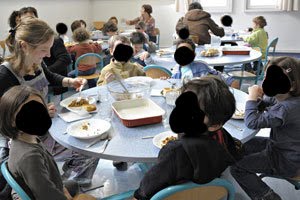
Each day French school children have two hours for lunch. They can either come home and eat with their families or stay at school and eat in the cantine. I don’t say ‘cafeteria’ because at our school it is not at all a cafeteria. There is no line, no lunch lady ladling food onto trays and no options or vending machines. Each day the children enter the cantine which is set up with tables already laid for lunch. Each place setting has a real plate, fork, knife and spoon along with a napkin, small glass and carafes of water. The children sit and are then served the first of four courses—entrée, plat, cheese and dessert.
First comes the appetizer or ‘entrée’ and it is usually a salad like shredded carrots in oil and vinegar, beets or radishes, sliced thin and served with butter and baguette. The lunch staff place the appetizer in the middle of the table and the children serve themselves. When they’ve finished this course the table is cleared and it’s on to the main or ‘plat’.
‘Plat’ consists of a meat and accompanying vegetables and starch. This is placed on separate platters in the middle of the table and the children serve themselves. Some examples of a lunch course are cordon bleu with green peas and potato gratin, lamb stew with couscous, or individual roast chickens with mashed potatoes and green beans. My children’s favorites are cordon bleu, which they describe as a chicken nugget stuffed with ham and cheese and breaded fish with lemon butter or beurre au citron.
Then follows a very integral part of the French table, the cheese course; sometimes it’s gooey cheese like Camembert, creamy cow cheese or tangy goat cheese rounds but  it can also be plain yogurt.  This is not always served with bread but depends on the style of cheese.
Finally, they have dessert. Every day.  It can be crème caramel, chocolate mousse or a piece of fruit.
And when they’re finished they go outside for a run around before settling back in for their afternoon lessons.
I would love to eat this way every day and find myself trying harder on the days my children are home for lunch and on the weekends to make them a balanced, warm lunch to share. Dinner isn’t a heavy meal and it makes more sense to go to bed having mostly digested your daily intake of food.
When you wonder why the French and other Europeans make such delicious food and are relatively healthier and thinner than we Americans you have to look no further than the school lunch. We are moving in this direction with all the interest in cooking, slow food, healthy choices and attention given to school lunches through blogs like Mrs. Q’s and that is a good thing. I am sure there is a future in providing healthier choices for our American children. It starts with all of us. One school lunch at a time.
Her children’s French school lunch menu for March can be viewed here: http://www.ville-lecres.fr/fichiers/596/menu-2011-03.pdf

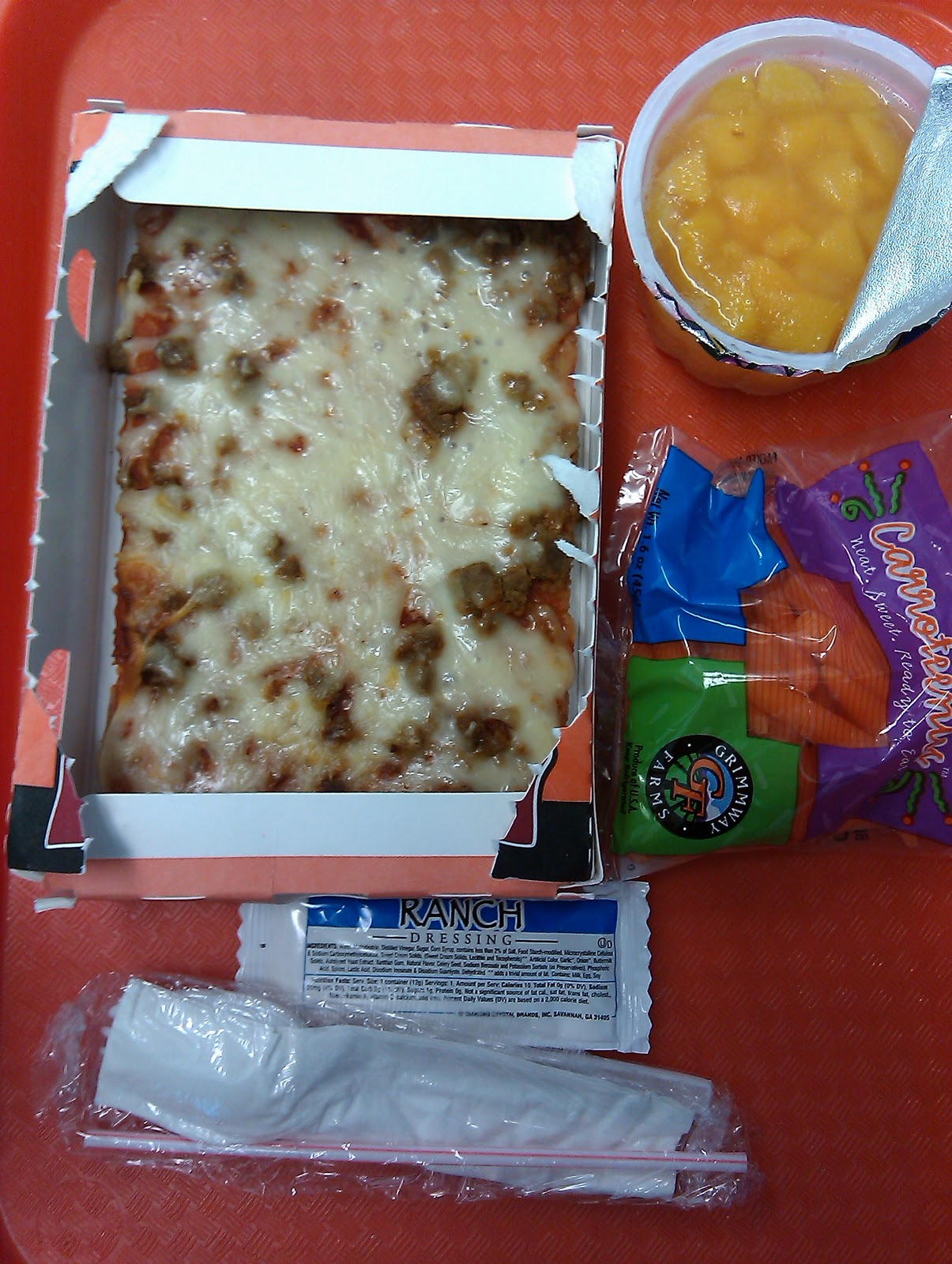
Day 115: pizza (and French school lunches)

Today’s menu: sausage pizza, fruit cup, carrots, ranch dressing

Sausage pizza is a new one. Before it was “pepperoni” pizza, which referred to not large circles of pepperoni, but small squares of….who knows. (Click here to examine all the school lunch pizza I have eaten).

I ate everything and went on with my day. It’s not the worse lunch I’ve eaten and it’s not my favorite. There is nothing more to say. I plan on avoiding eating pizza at school permanently come 2011.

***

Recently many twitter followers notified me that on Sunday Morning there was a segment on school lunch. I clicked over and watched it here: France’s Gourmet School Lunches

I suggest you watch the whole thing. I was blown away and got choked up around minute 3:50, which was a weird place to get a lump in your throat as the chef was talking about fish stock and not wasting any part of the fish. I think it was the cumulative effect of everything they do for kids’ nutrition and all the lengths that the French people go to to feed their students in a way that is completely foreign to our way of eating.

At minute 5:30ish the American mom displays the menu for her son (attending French school) and calls it “a work of art.” Yeah, let’s see. They do it better over there. It’s kind of like they are living on another planet where they care and respect food AND the small people who eat it.

***

Tomorrow the Child Nutrition Act expires. Please do try again to notify your member of the House and suggest somebody do something. Is there something wrong with our country? Will an extra 6 cents per meal even help?

Guest blogger: French School Lunches

Hi I’m Ann. I’m an English teacher married to a Frenchman but currently sans work permit, which means I have a lot of time on my hands for musing about all things French and American on my blog: http://adventuresintoulouse.blogspot.com/

When my cousin came to visit me in France last year, he commented that the children here act like “little adults.” It’s not an uncommon remark, and it may be because French children are expected to eat like little adults. It is common knowledge that the French take their food VERY seriously; these people don’t mess around and school lunches are no exception. While it’s certainly nothing fancy, the French would describe it as correct, which simply means that it’s well-balanced, affordable and perfectly fine to eat.

French children have the option of eating in the school cafeteria or going home for lunch. For those who decide to eat at the cantine, lunch lasts anywhere from 30 minutes to an hour, usually followed by a comparable amount of recess.

Cafeteria workers and other assistants are there to supervise the meal. They make sure that each child tries what is on his plate and that food does not go to waste unnecessarily. They’re also available to help younger children cut their meat or peel their fruit. For children ages 3-6, meals are served family style at small tables using real plates, glasses and silverware. Self serve cafeteria lines are generally reserved for older children, which allows for speedier service and more autonomy.  Everyone drinks water.

Lunch begins with the entrée, usually some sort of small salad or soup followed by the main dish. Typically you’ll have a protein source with a side of vegetables or carbohydrates. Dessert consists of fruit and yogurt more often than not. Treats such as cake, pastries and other sugary desserts only make their way to the table once a week at the cafeteria, though most French children enjoy some sort of cookie around 4:30 or 5:00 for their afternoon snack.

Since 2008, organic food has been making regular appearances at cafeterias here in Toulouse. 25,000 elementary school students currently enjoy meals that contain one organic item and organic bread is served daily. The idea is that students who eat lunch at school will have consumed the equivalent of one organic meal over the course of the week. Not bad! 

Families pay for their children’s lunches depending on their earnings and the number of children they’re supporting. For those earning less than €914 per month (after taxes), lunch is free. For families earning more than €4500 per month, lunch costs €3.45. For those whose earnings fall somewhere in between, they can expect to pay between €1.65 and €3.30. If you’re a teacher who would like to eat the school lunch, it costs €3.80. For prices to fall into these ranges, the meals are partially subsidized by the government.

The government is also very aware that American tastes are catching on over here –fast food, snacking, and soda are very popular. In an effort to curb these bad habits, vending machines have been banned from schools since 2005. An extensive ad campaign has also been in effect for several years now. Advertisements run on TV and radio reminding everyone to: eat five fruits and vegetables every day, to exercise regularly, to avoid snacking in between meals and to consume three dairy products. It gets in your head after a while. It’s surprisingly hard to ignore.

On television recently, I ran across a program that profiled middle school students and what they most liked to see on the cafeteria menu: pizza, quiche Lorraine and French fries were their favorites. No surprise there! But since these aren’t the healthiest choices, it is probably best that the kids are not the ones deciding. This is something I came across fairly frequently while perusing parenting blogs in French: even if your child complains about eating at the cafeteria, it’s important for him to get in the habit of eating what is being served. Food for thought…

And maybe that’s the biggest difference: there’s no pandering to children’s tastes around here. The expectation is that parents, and in this case schools, feed their children things that they too would eat. Both the preparation and the presentation send a clear message: we care about you; we want you to eat well, take your time and use good manners. Bon appétit!

I’ve included a sample menu below, does this look like something you’d want to eat?

A Sample Menu

Monday
Potato and leek soup
Salmon cubes in lemon butter
Vegetable galette
Plain organic yogurt
Apple

Tuesday
Green Salad
Roasted organic chicken
French fries and ketchup
Gouda                                                                       
Mixed fruit salad

Wednesday
Pumpkin soup
Croque Monsieur (a grilled ham and cheese sandwich)
Mixed baby greens
Plain organic yogurt
Marble cake 

Thursday
Beet salad
Turkey skewers
Organic lentils
Camembert cheese
Kiwi

Friday
Mixed baby greens
Veal stew
Organic pasta with butter
Cantal cheese
Clementine


**Thanks so much to our guest blogger from France! She shared the photos with me and I blocked out the kids’ faces due to privacy concerns.**